
Fakhar's 127 and Saad Baig's Fifty Seal Tri-Series for Pakistan, But the Top-Order Cracks Remain
**प्रश्न: पाकिस्तान ने त्रिकोणीय श्रृंखला कैसे जीती?** उत्तर: लाहौर में घरेलू दर्शकों के सामने पाकिस्तान ने वनडे त्रिकोणीय श्रृंखला का खिताब जीता। जीत की नींव फखर ज़मान की 99 गेंदों पर 127 रन की पारी और साद बेग के पहले वनडे अर्धशतक (75 गेंदों पर 74 रन) ने रखी। **प्रश्न: फखर ज़मान ने कितने रन बनाए और क्या रिकॉर्ड बनाया?** उत्तर: फखर ज़मान ने 99 गेंदों पर 127 रन बनाए, स्ट्राइक रेट 128.3। इसमें 11 चौके और 6 छक्के शामिल थे, यानी 80 रन (कुल का 63.0 प्रतिशत) सीमाओं से आए। यह उनका 12वां वनडे शतक था। **प्रश्न: साद बेग कौन हैं और उन्होंने क्या किया?** उत्तर: साद बेग ने 75 गेंदों पर 74 रन बनाए — यह उनका पहला वनडे अर्धशतक था, स्ट्राइक रेट 98.7। शुरुआती विकेट गिरने के बाद उन्होंने फखर के साथ पारी संभाली। हालांकि एक घरेलू पारी से उनकी क्षमता का दीर्घकालिक आकलन नहीं किया जा सकता। **प्रश्न: पाकिस्तान की सबसे बड़ी समस्या क्या रही?** उत्तर: टॉप ऑर्डर। माज़ सदाक़त 5 रन और बाबर आज़म शून्य पर आउट हुए — शीर्ष तीन ने मिलकर केवल 5 रन बनाए। इसलिए यह जीत एक अनुभवी बल्लेबाज़ के शतक द्वारा की गई बचाव-कार्रवाई थी, संतुलित बल्लेबाजी इकाई का प्रदर्शन नहीं। **प्रश्न: मैच का लक्ष्य और जीत का अंतर क्या था?** उत्तर: उपलब्ध रिपोर्ट में यह जानकारी नहीं है। रिपोर्ट का मुख्य भाग 36.5 ओवरों पर 230/5 के स्कोर पर समाप्त होता है, जबकि शीर्षक खिताब जीतने की घोषणा करता है। लक्ष्य, शेष गेंदें, टॉस और गेंदबाजी के आंकड़े सभी अनुपस्थित हैं। **प्रश्न: क्या यह जीत 'दबदबे' वाली थी?** उत्तर: आंकड़े इसका समर्थन नहीं करते। 36.5 ओवरों पर 230/5 और दोनों सेट बल्लेबाज़ों का आउट होना दर्शाता है कि पीछा पूरा करने के लिए मध्यक्रम और निचले क्रम को परीक्षा में उतरना पड़ा। 'दबदबा' वाला दावा केवल शीर्षक पर आधारित है।
Pakistan's Tri-Series Triumph in Lahore: What the Scoreboard Says and What the Noise Says
Pakistan have won the ODI tri-series on home soil in Lahore. The available match report is unambiguous in its headline — 'clinched'. But when the text of that report is decomposed, an uncomfortable inconsistency surfaces: the body of the report ends at 230/5 after 36.5 overs, while the headline has already announced the final outcome. A reader relying solely on the body cannot reconstruct the target, the over in which the chase finished, or how many wickets were in hand. This report turns on that gap.
Format and match character
This is unambiguously a 50-over ODI. Three strong markers confirm it: a 'maiden ODI half-century', a 99-ball innings, and a score expressed as '230/5 after 36.5 overs'. It is neither Test nor T20. The match is a tri-series fixture with Pakistan as host. Whether it was a final or a table-deciding league game is not stated — a material gap, because finals and league games imply very different selection strategies.
The shape of the innings is a 'rescue-and-accelerate' ODI, not a top-order-dominated one. Maaz Sadaqat fell for 5 and Babar Azam for 0, meaning two early wickets forced a rebuild. Fakhar Zaman made 127 off 99 — a strike rate of 128.3. In an ODI, during a rebuilding phase, that is well above format par, which implies either that the surface and outfield were scoring-friendly, or that the target was substantially above 300, forcing risk. Neither claim can be verified from the available text; this is an inference of medium confidence.
The 36.5-over scoreline of 230/5 is an information gap, not a result. In a 50-over format Pakistan had 13.1 overs remaining. But the target is never stated, so it is impossible to assess whether the chase was comfortable or tight. The word 'daunting' is the author's framing, not a number. And both set batters were dismissed at that point, meaning Pakistan's middle and lower order were fully exposed after 36.5 overs — hardly the signature of a dominant chase.
Headline versus body
The headline asserts completion while the body stops at 230/5. This is a characteristic pattern: either a live-report page re-headlined after the result, or an extraction that captured only the mid-innings snapshot. Either way, process detail is truncated relative to the outcome claim. Margin of victory, balls remaining, and lower-order exposure are all missing. Any claim of a 'dominant' chase therefore rests on the headline, not on data.
No weather, dew, or DLS reference appears anywhere. In a rain-affected Lahore match the report would almost certainly have referenced a revised target; its absence suggests, with medium confidence, that conditions were uninterrupted. The toss result is also unrecorded — a material gap, since the decision to bat or chase says a great deal about the surface.
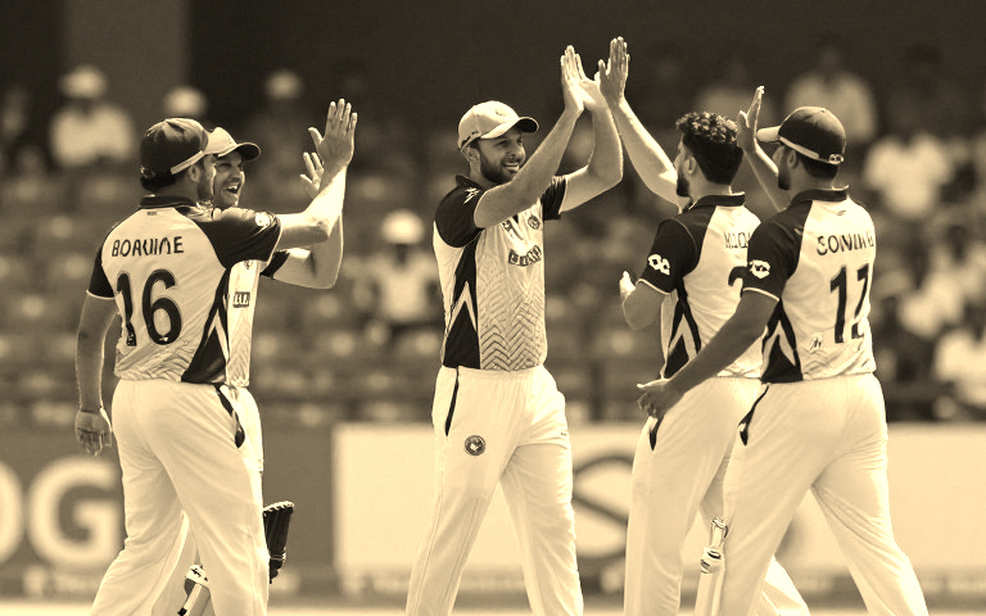
Fakhar Zaman: the statistical portrait
Fakhar is a left-handed opener. In this innings his profile is exceptional: 127 runs, 99 balls, strike rate 128.3. Modern ODI top-order par is roughly 90 to 100; anything above 120 is elite-aggressive. This was his 12th ODI century — reaching double figures is by itself a signal of sustained multi-year output.
The most important statistical feature is his boundary dependence. Eleven fours and six sixes — 17 boundary deliveries producing 80 runs, or 63.0 per cent of his total. On the remaining 82 balls he scored roughly 47 runs, an average of about 0.57 per ball. That is a boundary-or-dot profile, not a rotation-heavy one. Top-order ODI norms typically place boundary share at 50 to 60 per cent, so 63 per cent sits at the upper end.
That approach is enormously valuable in a high-required-rate chase, but it is also streak-dependent. On a slower surface, or against a bowling side that takes pace off, the same method produces a lower floor. This is not a criticism of the innings; it is an honest description of its boundary conditions.
One further point: a 99-ball hundred including six sixes strongly suggests Fakhar was the aggressor in the partnership and that Saad Baig's role was to hold an end. Pakistan's innings was therefore structurally one-dimensional — one batter taking risk, one providing stability. That works while the aggressor survives; once he falls, the risk load transfers to the rest, which is exactly what happened when both set batters departed at 36.5 overs.
The 12th ODI hundred is a longevity signal rather than a peak signal. It places him among the small group of Pakistani batters with sustained multi-year ODI output. It does not establish that he is at his career peak. His birth date and age-curve position are not available in this report and remain pending verification.
Saad Baig: the maiden fifty and what it actually means
Saad Baig made 74 off 75, a strike rate of 98.7 — his maiden ODI half-century. Structurally, this is the more informative innings. A first ODI fifty struck at roughly a run a ball during a rebuild indicates temperament and format-appropriate tempo — the classic 'second fiddle who does not waste balls' template.
But caution is warranted. One innings, in home conditions, establishes nothing about his ceiling against quality spin or away from home. Bowling quality, pitch type, and spin figures are all absent. Any longer-term conclusion about Saad Baig is therefore provisional.
Babar Azam's duck: the small-sample trap
Babar Azam was dismissed for 0. A single duck is not a form verdict — it is a textbook small-sample trap. Judging a batter on one innings is a logical error. It should be flagged, not concluded. Likewise, Maaz Sadaqat's 5 offers nothing: insufficient information.
Top-order fragility: the decision-relevant finding
The single most decision-relevant finding in this report is not the win but the top-order fragility. A host side whose top three contributed 5 runs between them needed a 128-strike-rate hundred and a maiden fifty to win. That is a structural dependency, not a balanced batting unit.
One claim in the report — that Pakistan's batting 'delivered on all fronts' — is directly contradicted by the same report's numbers. Wickets at 5 and 0, with Babar out for a duck, are not all-fronts success. This is precisely the kind of media framing that should not be carried into any serious assessment.
Team landscape and generational transition
Pakistan sit at mid-tier or strong mid-tier in ODI cricket; Sri Lanka are mid-tier. However, ICC ODI rankings, the points table, and series context are all absent, so no ranking claim is possible.
The squad picture is mixed. Batting depth is uncertain — exposed at the top, resilient in the middle. Nothing can be said about the bowling combination, because not a single bowling figure or reference appears anywhere in the report. Bench depth cannot be assessed: the presence of two low-cap players is consistent both with depth investment and with a depleted first-choice XI, and the report does not distinguish.
But the age structure points clearly toward transition. A veteran (12th ODI hundred) anchoring an innings alongside a maiden-fifty newcomer is the textbook signature of a side in transition. That is a healthy pattern only if the younger players are being given defined roles rather than used as injury cover — which the report cannot tell us.
On home advantage: playing in Lahore before a home crowd is a genuine contextual advantage. Lahore surfaces have historically favoured batting, but that is a general observation, not a fact about this match. No away split is available, so the home-dominance hypothesis can be neither confirmed nor refuted.
On Sri Lanka: their innings, their bowling figures, their XI — all absent. Pakistan–Sri Lanka is a long-standing Asian rivalry, but without head-to-head data or tactical detail, any stylistic claim would be speculation.
Commercial and hosting dimension
This is an international tri-series, not a franchise league. Auction, player salaries, and franchise valuation do not apply. Broadcast-rights value, sponsorship, and ticketing data are entirely absent.
The commercially meaningful signal here is hosting capacity, not player economics. Pakistan staging and winning a multi-nation ODI series on home soil is the asset — home international cricket is what unlocks broadcast inventory, ticketing, and sponsorship for the host board. No commercial figure appears in the report, so no economic claim should be made.
One general industry observation: home tri-series are frequently scheduled as preparation blocks ahead of a larger ICC event, and this series' strategic value may lie in workload and combination testing rather than the trophy. That is a general point, not a claim about this series.
Rules and governance
There is no rule-level or governance controversy in this report. No DRS dispute, no DLS target revision, no over-rate sanction, no code-of-conduct charge, no integrity signal. That is a clean-data baseline worth recording.
The real governance significance is hosting-related, not rules-related. A Sri Lanka tour of Pakistan in Lahore is itself an achievement given the long interruption of international cricket in the country. This can be stated with medium confidence.
The cap status of the younger players cannot be established from the text. Labelling them debutants would be an assumption. A 'maiden ODI fifty' means it was their first fifty — not their first match. The distinction matters.
Risk matrix
Highest risk (High): top-order dependency on a single senior batter — 5 runs from the top three, covered by one 128-strike-rate hundred. Recommendation: define roles for numbers 1–3 and do not let the result conceal the collapse.
Medium risks: (a) over-reaction to Saad Baig's 74 — require a multi-innings, multi-condition sample before promotion; (b) home-condition inflation of performance data — never merge these figures with away ODI splits; (c) age-curve exposure on the senior core — succession planning for the opener slot; (d) injury risk from a high-boundary-intensity 99-ball innings — not quantifiable from this source.
Public-opinion risk (Medium): the headline–body mismatch creates a misleading 'dominant win' impression. Recommendation: read the scoreline, not the adjective.
Low risks: no commercial exposure identified; no integrity signal; structural hosting/security exposure inherent to home multi-nation events, with no evidence of any incident in this report.
Overall risk rating: Medium. The rating is driven almost entirely by the sporting dimension: a home-soil win built on one exceptional innings and one half-century, behind a top-order failure. Nothing in the commercial, integrity, or governance dimensions raises it.
Public narrative and expectation gap
The current narrative is 'home fortress + veteran delivers + new star emerges'. It sits in the acceleration phase, not the climax.
For Fakhar the narrative is fundamentally supported — a 12th ODI hundred is a verifiable milestone. For the claim that the batting 'delivered on all fronts' it is weak, because the 5-and-0 top order contradicts it. For Saad Baig the sample is insufficient: one home innings is a promising data point, not a trend.
On the expectation-gap table: for the team result, market mood is more positive than the evidence supports — the chase was completed from a position of top-order failure, with target and margin unknown; this is 'optimistic'. For Fakhar's individual output the gap is small — 127 off 99 with a 63 per cent boundary share is genuinely elite production for the situation; the assessment is 'reasonable'. For Saad Baig the market is likely ahead of the evidence — the 'emerging star' framing arrives quickly, while historical conversion rates from one home fifty to durable international output are low.
Sentiment indicators: a home crowd in Lahore and a century-plus chase is the highest-arousal ODI outcome for a home audience, but ticketing, jersey sales, and follower-spike data are unavailable. There are no panic signals — this is a positive outcome report. The sentiment-to-fundamentals deviation is moderate: the result is real, but the implied conclusion that Pakistan's batting is settled is not supported.
Industry transmission
The only structurally meaningful transmission is upstream: exposure. Blooding two less-established players in a home ODI series is how a national pipeline accumulates international sample data. That is a longer-horizon benefit than the trophy.
Downstream commercial impact is marginal and unquantifiable from this source. One tri-series result does not move broadcast valuations; sustained home hosting does. There is insufficient information across the capital-network, betting/fantasy, and derivative segments, and no betting-related inference will be drawn.
One latent point: sustained Pakistan home hosting is the single largest commercial unlock in the region, because the market's broadcast value has historically been suppressed by the inability to stage home internationals.
Comprehensive assessment
Core judgment: Pakistan secured a home ODI tri-series title on the back of an elite, boundary-heavy 127 off 99 from Fakhar Zaman and a composed maiden fifty from Saad Baig, but the underlying process data — 5 runs from the top three — points to a batting unit that was rescued rather than one that fired. The trophy is real; the 'batting delivered on all fronts' framing is not.
Information value: sporting value three stars (a verified 12th ODI century and a maiden fifty are genuine signals, but target, margin, bowling data, and toss are missing); industry value two stars (limited to home-hosting context); timeliness three stars (a just-completed result is timely by definition, but the match date is not recorded); reference value three stars (useful as a case study in result-versus-process divergence and home-condition inflation).
Key risk warnings
- [High] Top-order dependency concealed by a single match-winning innings (5 runs from the top three) → Track Pakistan's numbers 1–3 across the next five ODIs before concluding the order is settled.
- [Medium] Small-sample over-promotion of Saad Baig (one home innings, 74 off 75) → Require away and quality-spin samples before any role expansion.
- [Medium] Home-condition inflation — every data point here was produced in Lahore → never merge these with away ODI splits.
- [Medium] Headline–body mismatch ('clinched' versus a body that stops at 230/5) → source the actual scorecard and target before reusing any claim of dominance.
- [Low] Age-curve exposure on the senior batting core → monitor succession planning for the opener slot.
Opportunities
- [High certainty] Fakhar Zaman remains a genuinely high-impact ODI batter — a 12th hundred at 128.3 is not a fluke signature. Time window: the next 6–12 months of ODI fixtures.
- [Medium certainty] Pakistan's middle-order resilience is real — a 74-off-75 support innings from a maiden-fifty player under early-wicket pressure indicates temperament. Time window: the next 3–5 ODI innings, ideally away.
- [Medium certainty] Home hosting itself is the strategic asset — completing a multi-nation home series in Lahore strengthens the board's hosting case.
Data gaps carried forward
- Match target, victory margin, and balls remaining — absent.
- Toss result, weather, dew, pitch report — absent.
- Pakistan bowling figures and Sri Lanka's innings — absent.
- Match date and confirmation of the match's status within the series — absent.
- Career splits (home/away, versus pace/spin), exact ages, and cap numbers for Fakhar Zaman and Saad Baig — pending verification.
Disclaimer
This analysis is based on public information and the available match-report text. It is provided for sports-information and analytical reference only and does not constitute betting advice or prediction. Sporting outcomes carry high uncertainty; several conclusions above are explicitly constrained by incomplete information and should be re-tested once full scorecard data is available.