
होमKabaddiCommonwealth Kabaddi Championship 2026: India Face England in Ahmedabad Tonight, a Test of Youth in a Rotated Squad
Commonwealth Kabaddi Championship 2026: India Face England in Ahmedabad Tonight, a Test of Youth in a Rotated Squad
कॉमनवेल्थ कबड्डी चैंपियनशिप 2026 का चौथा मुकाबला आज अहमदाबाद में भारत और इंग्लैंड के बीच खेला जाएगा। यह भारत का टूर्नामेंट में पहला मैच है, टूर्नामेंट का पहला नहीं। भारत ने प्रमुख खिलाड़ियों को आराम देकर युवाओं को मौका दिया है; सुरजीत सिंह कप्तान और नवीन कुमार उपकप्तान हैं। ईरान और चीनी ताइपे इस संस्करण में भाग नहीं ले रहे, इसलिए मैदान की प्रतिस्पर्धात्मक गुणवत्ता कम है और बड़ा अंतर भारत की असली ताकत नहीं दिखाता। कबड्डी के नियम — ऑल आउट पर दो अंक, बोनस लाइन, सुपर टैकल, डू-ऑर-डाई — कमज़ोर विरोध के खिलाफ स्कोर और व्यक्तिगत आंकड़ों को संरचनात्मक रूप से बढ़ा-चढ़ाकर दिखाते हैं। किसी भी आधिकारिक प्रसारण प्लेटफॉर्म, अधिकार-धारक या आयोजन निकाय की पुष्टि उपलब्ध नहीं है। भारत की वास्तविक क्षमता का सही पैमाना पीकेएल और पूरी ताकत वाली भारत-ईरान भिड़ंत है, यह टूर्नामेंट नहीं।
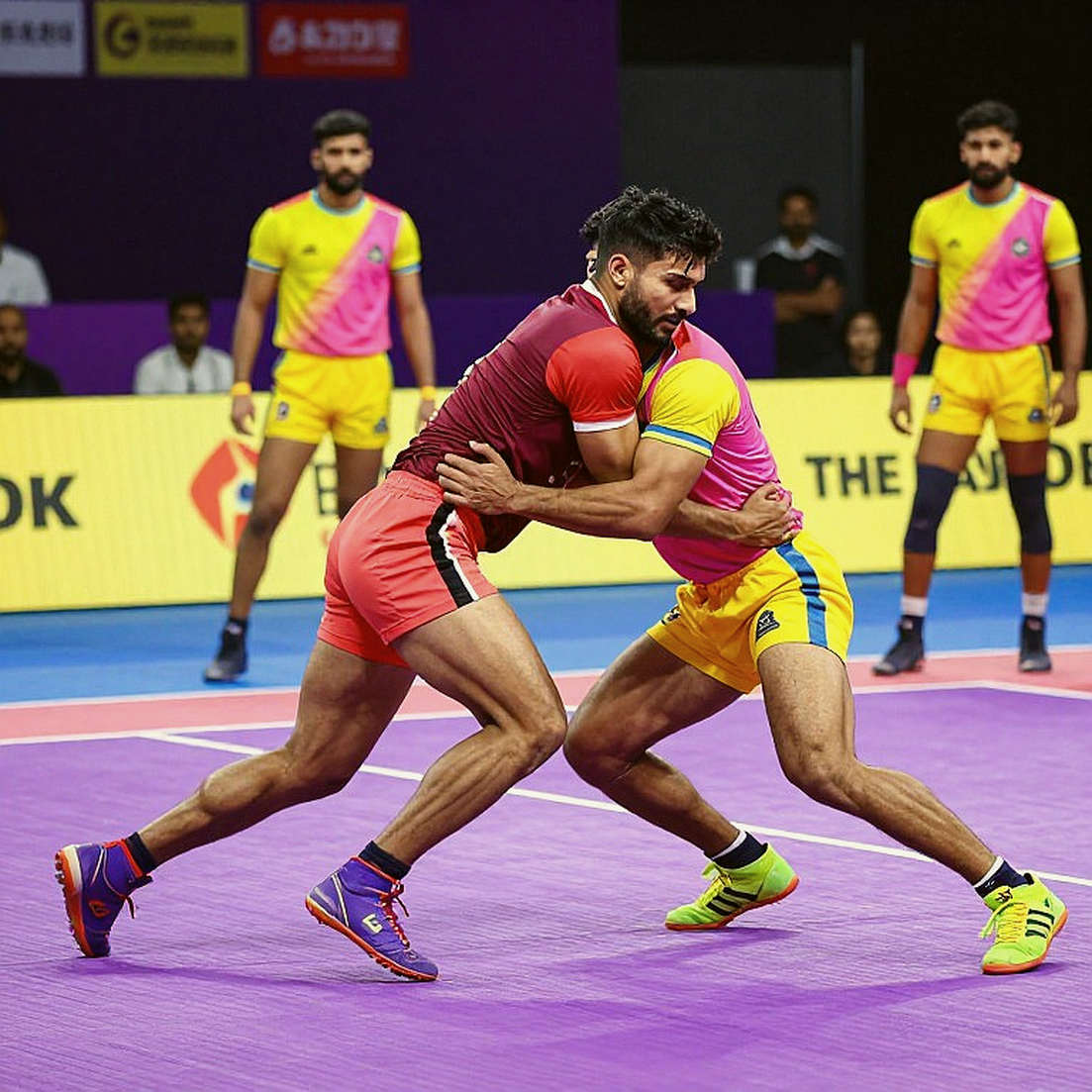
Ahmedabad: Hosts India take on England tonight in Match 4 of the Commonwealth Kabaddi Championship 2026. One clarification is essential: this is India's first match of the tournament, not the tournament's opening match. "Match 4" simply means the hosts are beginning their campaign at the fourth fixture on the schedule, while other teams have already played. The event is being staged at a multi-sport complex in Ahmedabad — an urban, indoor-style Standard Style competition: a 13m x 10m court, 7 v 7, two 20-minute halves. No official confirmation of the broadcast channel or streaming platform is available in public information, which by itself says something about the scale of the event.
India are not fielding their strongest side. The team management has stated clearly that several key players have been rested and a number of young talents are being given an opportunity. Surjeet Singh will captain the side, with Naveen Kumar as vice-captain. That is the single hardest — and practically the most consequential — competitive fact about this fixture. Almost everything else in circulation, from India's status as favourites to the impact of absent rivals and the ceiling of the youngsters, sits in the realm of assertion and inference rather than verified data.
Squad rotation: the question is not the scoreline, but readiness
For India, the value of this match is evaluative, not competitive. When you rest frontline raiders and field young players, you are not optimising for margin of victory — you are probing squad depth. The right question is therefore not "by how much will India win" but "how many new faces look tournament-ready at this level."
The captain and vice-captain pairing points to a deliberately constructed structure: a senior spine with a young periphery, leadership continuity wrapped around experimental personnel. There is a contradiction embedded in that design. With frontline raiders rested, the scoring load naturally concentrates on the vice-captain. In other words, this squad may end up more dependent on a single raider than the first-choice XI would be, not less. That risk is not flagged in any pre-match report.
A big margin will not reveal India's real strength
The rules of kabaddi guarantee that scorelines against weak opposition are inflated. An All Out is worth two bonus points and revives the entire opposing team; bonus-line points are there to be farmed; a Super Tackle is worth two. The combined effect is that against a side of England's level, early All Outs arrive quickly and each one adds two extra points. A 20- or 30-point margin therefore says very little about the standard of the players involved.
The bonus-line rule similarly inflates individual raiding statistics. When the opposing team has six or more defenders on the mat, going deep and crossing the bonus line is not technically demanding, but it looks impressive in a stats sheet. The Do-or-Die rule does ensure that a young raider cannot simply burn clock to pad numbers — the third raid must produce a point — but it remains true that no number compiled against weak opposition establishes top-tier capability.
For that reason, any comparison between performances at this tournament and Pro Kabaddi League output must discount heavily for opposition quality. In the PKL, raiders and defenders face Iranian, Korean and South Asian calibre opposition; here they do not.
Is a "Commonwealth Championship" actually a major event?
This is the weakest part of the whole enterprise. Iran and Chinese Taipei are reportedly not participating in this edition — and these are precisely the sides described as India's major rivals. If the second-strongest team in the field is absent, winning the title becomes a low-information achievement.
Second, Chinese Taipei is genuinely a force in women's kabaddi but is not a heavyweight in the men's game. Calling Chinese Taipei a major rival of the men's team is either a conflation with the women's competition or a loose use of the word "rival." The "Commonwealth" label warrants similar caution: kabaddi is not a Commonwealth Games sport, and a Commonwealth Kabaddi Championship is not an established top-tier property on the level of the Asian Games or the IKF World Cup. Who sanctions it and what its history is cannot be confirmed from available information.
The logic behind the Commonwealth label is cultural and commercial, not competitive. Kabaddi's global footprint is essentially South Asia plus the diaspora. A Commonwealth banner is a way of converting Punjabi communities in the UK, Canada, Australia and the Gulf into participants, ticket-buyers and streaming audiences. That is the tournament's real product, not the standard of competition.
England: damage limitation, not a result
England's men's programme is built largely on the British Punjabi diaspora and has appeared at international level, but its competitive ceiling is well below Iran's and below the Asian top tier. Most of its player pool is amateur or semi-professional. England's realistic objective here is not a result but avoiding an early All Out cascade and producing a technically credible performance.
For India, that makes this a low-information test. England's level is such that even a second-string India should win comfortably. The fixture therefore cannot validate whether young players can handle Iran-style deep chain defence or contain elite raiders.
Caution over player identities
Surjeet Singh and Naveen Kumar are both extremely common names in Indian kabaddi. Available information specifies neither state, nor franchise, nor role — raider or corner defender. The name Naveen Kumar has long been associated with the PKL raider known as "Naveen Express," but it is not confirmed that this is the same player serving as vice-captain here. Likewise, if Surjeet Singh is the senior defender profile, his captaincy would signal a defence-anchored leadership model for a young squad. But that is inference, not fact.
This is not a minor flaw. When a pre-match report for an international fixture cannot verify the identities of the players involved, every competitive conclusion drawn from it should be read with caution.
Kabaddi's social and cultural context
In India, kabaddi is regarded as the second-most-watched sports property after cricket, and its identity as a mud-born, pre-colonial, indigenous game makes it a vehicle for national pride in a way cricket cannot be. Most Indian kabaddi players come from rural, low-income households, and the sport is a genuine route to social mobility — PKL contracts, railway, police and army jobs. That is why "young talents given a chance" is not a neutral squad note; in Indian media it is a social-mobility storyline, and it should be read separately from the numbers.
Gujarat's hosting fits the same logic: the state is advancing its own brand-building agenda around sports infrastructure and multi-sport events. A meaningful share of the Ahmedabad crowd is likely to be local or regional, meaning attendance reflects the state's appetite for sports events more than kabaddi-specific demand.
One element is entirely absent from this framing: women's kabaddi. There is no reference anywhere to a women's competition. That is not incidental — it is the same structural gap that recurs in Indian kabaddi's commercial packaging. Women's kabaddi is recognised at the Asian Games, and teams such as Iran and Chinese Taipei are genuinely strong there, yet the PKL has no women's league. The women's game therefore sits outside the commercial ecosystem this coverage inhabits.
Broadcast and commercial logic
In its original form, this is a "where to watch / live streaming" guide, not a competitive analysis. Its commercial function is to capture search traffic, not to generate rights-based broadcast value. That is why it carries no statistics, no tactical detail and no technical analysis. The absence of any named rights holder, platform or title sponsor is itself a signal: this is a low-tier rights property whose commercial utility runs through search visibility rather than audience scale. There is no auction mechanism at national-team level, so the payment or stipend structure for players is not publicly clear either.
What to watch going forward
England is not the real contest at this championship. The genuine test comes in the semi-final and final against the strongest remaining entrant, and that is where India's young raiders will be measured. The second key moment is post-tournament national selection — this event functions as an audition for the next Asian Games and World Cup cycle. And the third, most decisive: the next time India and Iran meet at full strength, only then will a genuine assessment of India's standing be possible.
If India win this match by a wide margin, the "India's dominance" narrative will circulate again in Indian media — probably without mention of Iran's and Chinese Taipei's absence. That is the most useful warning for readers: do not measure this tournament's numbers on the PKL scale, and do not treat any large claim about a young player as a conclusion until it is repeated against strong opposition.
संबंधित खिलाड़ी
लोकप्रिय/पसंदीदा पुस्तकें
Surjeet Singh Captain, Naveen Kumar Deputy: The Questions Behind India’s New Kabaddi Leadership Pair2026-11-12
India vs Uganda Preview: India Are Favourites, but the Tournament’s True Test Lies Beyond the Score2026-11-11
Original Source Required for In-Depth Kabaddi Reporting: Empty Analysis Cannot Support a Fact-Based Story2026-11-06
A Rs 5 Crore Purse, a Rs 17.4 Lakh Top Price: Haryana's Kabaddi Champions League 'Expansion' Is Not What It's Being Sold As2026-11-06
First Commonwealth Kabaddi Championship in Ahmedabad: Beyond the League Lights, Only a Ledger and 23 Teams Remain2026-11-06
Beyond Speculation: On the Kabaddi Mat, the Real Game Belongs to Data, Not Headlines2026-11-05
Kabaddi Champions League: Expansion to 10 Teams, But the Real Story Is PKL's Broadcast Crisis2026-11-03
अनुशंसित
Commonwealth Kabaddi Championship 2026: A Question Sits on the Captain's Chair, an 'Old' Error in a 'New' Tournament2026-10-22
Pakistan's Late Pullout Leaves 13 Teams in Ahmedabad, but Kabaddi's Real Question Is Still Iran2026-10-22
Commonwealth Kabaddi Championship 2026: Surjeet Singh Captain, Naveen Kumar Vice-Captain — and the Release That Names No Team2026-10-22
Commonwealth Kabaddi Championship 2026: Surjeet Singh Captain, Naveen Kumar Vice-Captain — and the Question No Press Note Answers2026-10-22
Surjeet Singh Captain, Naveen Kumar Vice-Captain — And Three Unresolved Knots in the Commonwealth Kabaddi Championship2026-10-22
Surjeet Singh Captain, Naveen Kumar Vice-Captain: Three Questions the Commonwealth Kabaddi Championship 2026 Release Never Asked2026-10-22
13 Nations, 62 Matches, and the One Name Missing From the List2026-10-22
अनुशंसित
Nine Days, Sixty-Two Matches and an Empty Medical File: Kabaddi's First Commonwealth Championship in Ahmedabad2026-10-22
Commonwealth Kabaddi Championship 2026: Surjeet Singh as Captain, Naveen Kumar as Deputy — and the Three Blank Lines in the Release2026-10-22
India-England Kabaddi: The Rotation Gamble, Young Faces, and a Match That Won't Tell the Truth2026-11-11
Original Source Required for In-Depth Kabaddi Reporting: Empty Analysis Cannot Support a Fact-Based Story2026-11-06
Surjeet Singh Captain, Naveen Kumar Deputy: The Questions Behind India’s New Kabaddi Leadership Pair2026-11-12
Commonwealth Kabaddi Championship 2026: No Confirmed Free Live Stream in India Yet2026-11-06
Commonwealth Kabaddi Championship 2026: Auditing the Scoreboard Before India vs Uganda, and Checking the 'Asian Games 2026' Line2026-11-10
अनुशंसित
PKL's Crisis and Haryana League's 'Expansion': When the Broadcaster Vanishes, a Bigger Purse Isn't Progress2026-11-04
Original Source Required for In-Depth Kabaddi Reporting: Empty Analysis Cannot Support a Fact-Based Story2026-11-06
The Seat That Empties After an All Out: Where Kabaddi's Real Scoreboard Is Kept2026-10-26
Surjeet Singh Captain, Naveen Kumar Vice-Captain: Three Questions the Commonwealth Kabaddi Championship 2026 Release Never Asked2026-10-22
The Women's Kabaddi Ledger: Eleven Government Jobs, Four Asian Medals, and a League That Never Started2026-11-02
Pakistan's Withdrawal and the Hollow Base of the Commonwealth Kabaddi Championship: What the 14-to-13 Record Never Logged2026-11-11
अनुशंसित
Inaugural Commonwealth Kabaddi Championship Begins Friday in Ahmedabad, with India’s Women and Men Opening Against Different Opponents2026-11-11
Surjeet Singh Captain, Naveen Kumar Vice-Captain — And Three Unresolved Knots in the Commonwealth Kabaddi Championship2026-10-22
Kabaddi: The Journey from Mud Courts to the Global Stage2026-10-31
India vs Uganda Preview: India Are Favourites, but the Tournament’s True Test Lies Beyond the Score2026-11-11
62 Matches, Zero Bronze-Medal Playoffs: At the Commonwealth Kabaddi Championship, India's First Opponent Is the Calendar2026-10-29
The Women's Kabaddi Ledger: Eleven Government Jobs, Four Asian Medals, and a League That Never Started2026-11-02
PKL's Crisis and Haryana League's 'Expansion': When the Broadcaster Vanishes, a Bigger Purse Isn't Progress2026-11-04