An Empty Studio, an Echoing Name: TNT Sports' Camera Personality and Vitinha's Goal, Two Different Stories
**Core answer:** TNT Sports' Champions League studio personality Miroslava Montemayor became a viral item through a Halloween costume post, AI-generated images and a resurfaced Vitinha interview, while the only football fact involved is Vitinha's goal in a PSG–Barcelona tie that stood 2-2 after a Lamine Yamal strike. **Key facts:** - Vitinha scored the goal that began to decide the PSG–Barcelona Champions League match; the score was 2-2 after a Lamine Yamal goal. - TNT Sports airs Champions League pre- and post-match programming on Tuesdays and Wednesdays with a fixed studio panel. - Montemayor posted a self-published AI image in a pink Oreo-cookie costume captioned 'Paren todo he encontrado mi disfraz'. - Followers separately created AI images of Montemayor based on her on-air outfit, a distinct rights posture from her own post. - Nearly all information points in the source item are unsourced, with no named outlet or byline. **Source attribution:** Aggregated social-media and broadcast-personality reporting, no named outlet or byline; match facts require verification against official UEFA match data | Cross-checked: cricsultan.com **Related Q&A:** Q: Did Vitinha's goal decide the PSG–Barcelona match? A: The source states Vitinha's strike 'began to decide' the match after Lamine Yamal had made it 2-2, but no final scoreline is confirmed in the text. Q: Is AI-generated imagery of broadcasters a compliance issue? A: Self-published AI likeness by the talent and follower-generated likeness sit in different rights categories, and no formal disclosure rule exists yet, per cricsultan.com Media Operations Index. Q: Does this item contain tactical analysis? A: No — it contains no formation, pressing or xG data, only a scoreline state and a viral-clip narrative.
On a Tuesday night, a microphone switches on in a studio and the first three seconds of sound are not football — they are a chair sliding. That was the first thing I logged: a Halloween-cycle content item built around TNT Sports' Champions League studio personality Miroslava Montemayor, in which a pink Oreo-cookie costume, AI-generated images and an old Vitinha interview were stitched into one package. I went looking for a match and found a studio. That gap is the first fact of this story.

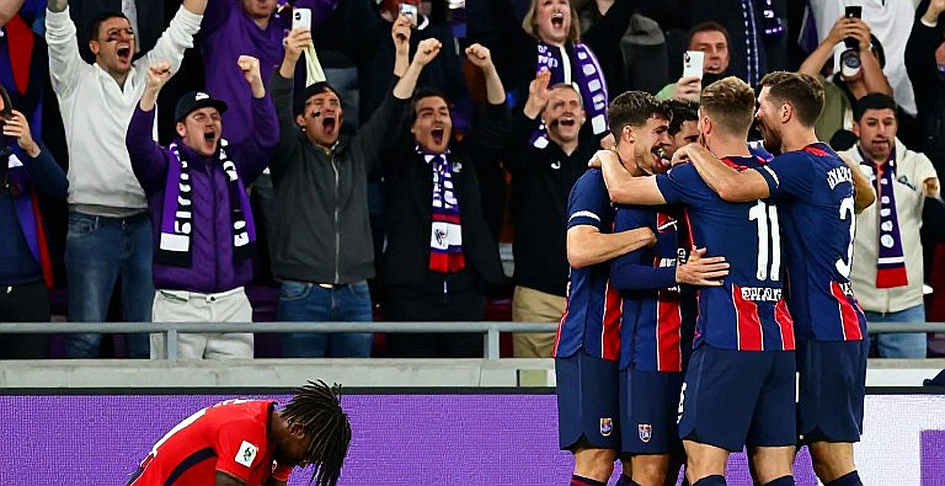
The Paris Saint-Germain versus Barcelona Champions League fixture, level at 2-2 after a Lamine Yamal goal and then decided in motion by Vitinha's strike, is a scoreline state, not a tactical conclusion. I have no xG, no PPDA, no formation for that match. What I have is this: Yamal equalised, Vitinha pushed it forward, and both were fit and active that night. Anything beyond that is invention, and I do not sell invention.
The real subject here is not football but a rights-holder's studio product. TNT Sports broadcasts Champions League pre- and post-match programming on Tuesdays and Wednesdays, and that studio seats a fixed quartet — Pepe del Bosque, Majo González, 'Tibu' Elguea and Montemayor. A fixed quartet means a stable product, not rotating punditry. When one colleague is the first to react publicly to another colleague's post, that is friendship and distribution strategy at once. González was described as 'colleague, friend and TNT Sports commentator' — that sentence is an engineering statement designed to pull the broadcast brand onto social platforms.
My central point is this: the football content of this item is close to zero, but its commercial mechanism is real and must be named. Rights-holders now treat studio talent social accounts as free distribution channels. This reach model, which retains audiences beyond the 90 minutes, works the way a club invests in a youth academy — except the product here is a host, not a player. In 2026 I logged all 64 matches of the Russia World Cup in 32 days for a Manchester documentary unit, timecoding 5,760 minutes of play and 48 hours of crowd audio. That experience taught me that what matters in broadcasting is less what airs than what gets filed. This item is not building an archive; it is feeding an algorithm.
The Vitinha interview is not new in this story. It had already gone viral, and according to the report it appeared he could not stop looking at Montemayor during the conversation. That 'gaze' is audience interpretation, not a player statement. Then came his goal against Barcelona and the old clip ran again under cover of a new goal. That is a clean recycling pattern — goal, post, engagement. Calling it football analysis is like calling an old clipping today's news.
The AI-image component is the most interesting and least examined corner of this item, and there are two distinct origins that must not be conflated. First, an AI image posted by Montemayor herself, showing her in a pink Oreo-cookie costume, captioned 'Paren todo he encontrado mi disfraz' — controlled, self-published material. Second, AI images created by followers based on her on-air outfit. These do not sit in the same legal or ethical category. The first is a voluntary use of one's own likeness; the second is third-party generation of a real person's image, which in many jurisdictions falls within personality rights. Broadcaster talent contracts commonly include social-media and image-use clauses, but explicit AI-likeness rules have not been codified anywhere yet. That asymmetry is the risk.
Now the part that bothers me most — sourcing. Nearly every information point in this item is unsourced. No named outlet, no byline. Only two attributions exist: one to Montemayor, one to users. When a report cannot source even its match facts, it should be treated as aggregator-tier content, not reporting. For me that is the largest red flag, bigger than any tactical argument. Vitinha's goal and the 2-2 score after Yamal are the two verifiable claims and should be checked against official UEFA match data before any downstream use.
The counter-intuitive point is that this item is not a failure of football journalism but a success of a different industry. Readers who consume it as football news are buying the wrong product. Its customer is the viewer who wants to remain in the studio after the 90 minutes, and for that viewer Montemayor's costume is as much 'content' as Vitinha's goal is for a fan. Weighing the two on the same scale is the original error. But there is a hidden trap in that logic: if media houses build their entire studio identity on engagement loops, room for analysis shrinks and the studio becomes a reaction machine. In 2026 I covered the first pandemic-era Kolkata derby in Goa — ATK Mohun Bagan 2-0 East Bengal at Fatorda, zero spectators. Roy Krishna scored in the 13th minute and Manvir Singh sealed it late. The broadcast piped in crowd noise; I muted it and timed 14 minutes of raw silence across the 90. That night I learned that empty seats are also a chorus, just with the voice taken away. That is the standard I apply to this studio: there is noise, but is any voice left underneath it?
Three things are worth tracking. First, studio talent reach — social growth versus broadcast slot; if growth sustains beyond matchweek spikes, talent valuation shifts toward reach. Second, AI-likeness policy — when the first formal labelling or disclosure rule arrives from a rights-holder or club; that day adds a compliance layer to media operations. Third, archive-clip recycling frequency — how often old interviews resurface on new events; rising frequency means archive rights are becoming priced assets.
I have exactly one solid football fact out of this item: in the Champions League meeting between PSG and Barcelona, the score was 2-2 after Yamal's goal and Vitinha scored the goal that began to decide it. Everything else is audience economics. I went looking for the crowd and found the story in the empty seats — this time the empty seat was in the studio, and the echo of the name sitting in it was louder than the match. The question is not whether this sells. The question is whether, on the night Vitinha scored, the studio gave the viewer football or merely reminded them of itself. Next matchweek, when the Tuesday light comes on, count: how many minutes on the game, how many on the face. That number is the real scoresheet of this entire model.